When to use these helpers
Prefer a small explicit condition over a long nested expression. Evaluate null and empty values deliberately before using a result to change a status, routing decision, or public output.Calling style
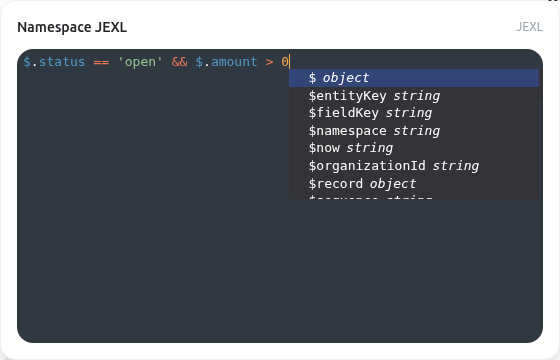
Call a helper asbetween($.requested_amount, 1000, 10000). Not every helper is available everywhere: validation, form, and document-template helpers have distinct context contracts. Editor suggestions are not proof that a helper is supported at runtime.
Complete function reference
andFn
Combines two truthy checks.
Signature: andFn(left, right)
Example:
value | andFn(...).
between
Checks whether a numeric or comparable value is inside an inclusive range. This is the active between helper; the earlier text-extraction registration is overwritten.
Signature: between(value, minimum, maximum)
Example:
value | between(...).
coalesce
Returns the first non-null value.
Signature: coalesce(first, fallback)
Example:
value | coalesce(...).
defaultTo
Returns the first argument that is not null or undefined; an empty string is retained.
Signature: defaultTo(...values)
Example:
value | defaultTo(...).
eq
Compares two values with loose equality.
Signature: eq(left, right)
Example:
value | eq(...).
equalsAll
Checks whether every variadic candidate equals a value.
Signature: equalsAll(value, ...candidates)
Example:
value | equalsAll(...).
equalsAny
Checks a value against any variadic candidate.
Signature: equalsAny(value, ...candidates)
Example:
value | equalsAny(...).
gt
Checks whether the first value is greater than the second.
Signature: gt(left, right)
Example:
value | gt(...).
gte
Checks whether the first value is greater than or equal to the second.
Signature: gte(left, right)
Example:
value | gte(...).
hasProperty
Checks whether an object has a property.
Signature: hasProperty(value, property)
Example:
value | hasProperty(...).
ifElse
Returns one of two values based on a condition.
Signature: ifElse(condition, whenTrue, whenFalse)
Example:
value | ifElse(...).
inOp
Checks whether a value exists in a string or list.
Signature: inOp(value, collection)
Example:
value | inOp(...).
inRange
Checks a value against one or more inclusive [minimum, maximum] ranges.
Signature: inRange(value, ...ranges)
Example:
value | inRange(...).
instanceOf
Checks a value against a constructor supplied by the evaluation context.
Signature: instanceOf(value, constructor)
Example:
value | instanceOf(...).
isNotNull
Checks whether a value is present.
Signature: isNotNull(value)
Example:
value | isNotNull(...).
isNull
Checks whether a value is null or undefined.
Signature: isNull(value)
Example:
value | isNull(...).
isType
Checks a value against a named JavaScript type.
Signature: isType(value, type)
Example:
value | isType(...).
like
Matches text with a percent-wildcard pattern, case-insensitively.
Signature: like(value, pattern)
Example:
value | like(...).
lt
Checks whether the first value is less than the second.
Signature: lt(left, right)
Example:
value | lt(...).
lte
Checks whether the first value is less than or equal to the second.
Signature: lte(left, right)
Example:
value | lte(...).
ne
Checks loose inequality.
Signature: ne(left, right)
Example:
value | ne(...).
not
Negates a truthy or falsy value.
Signature: not(value)
Example:
value | not(...).
notEqualsAny
Checks whether a value differs from every variadic candidate.
Signature: notEqualsAny(value, ...candidates)
Example:
value | notEqualsAny(...).
notIn
Checks whether a value does not exist in a string or list.
Signature: notIn(value, collection)
Example:
value | notIn(...).
notLike
Checks that text does not match a case-insensitive percent-wildcard pattern.
Signature: notLike(value, pattern)
Example:
value | notLike(...).
orFn
Combines two truthy checks.
Signature: orFn(left, right)
Example:
value | orFn(...).
regex
Matches text with a regular-expression pattern.
Signature: regex(value, pattern, flags)
Example:
value | regex(...).
safeGet
Reads a nested property without throwing for a missing value.
Signature: safeGet(value, path)
Example:
value | safeGet(...).
strictEq
Compares two values without type coercion.
Signature: strictEq(left, right)
Example:
value | strictEq(...).
strictNe
Checks strict inequality without type coercion.
Signature: strictNe(left, right)
Example:
value | strictNe(...).
xorFn
Returns true when exactly one input is truthy.
Signature: xorFn(left, right)
Example:
value | xorFn(...).
Before you publish
- Start with a known value and confirm the expected result.
- Handle null, empty text, and empty lists deliberately.
- Do not place secrets, access tokens, or sensitive personal data in an expression.
- Read expression contexts and availability before copying an expression between features.