When to use these helpers
Use these helpers to total values, compare thresholds, round outputs, and calculate ratios. They are registered as functions and transforms.Calling style
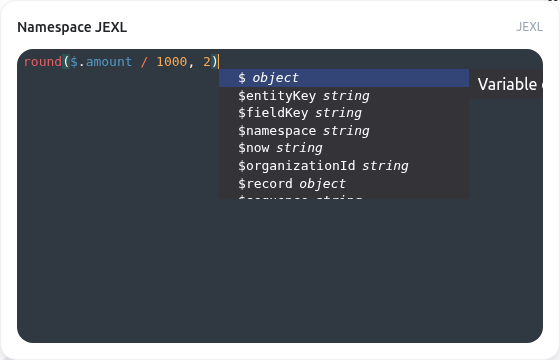
Call a helper asround($.requested_amount, 2). Not every helper is available everywhere: validation, form, and document-template helpers have distinct context contracts. Editor suggestions are not proof that a helper is supported at runtime.
Complete function reference
abs
Returns the absolute value of a number
Signature: abs(x)
Example:
value | abs(...).
acos
Returns the arccosine of a number
Signature: acos(x)
Example:
value | acos(...).
asin
Returns the arcsine of a number
Signature: asin(x)
Example:
value | asin(...).
atan
Returns the arctangent of a number
Signature: atan(x)
Example:
value | atan(...).
atan2
Returns the arctangent of the quotient of its arguments
Signature: atan2(y, x)
Example:
value | atan2(...).
avg
Returns the average of all arguments
Signature: avg(...values)
Example:
value | avg(...).
cbrt
Returns the cube root of a number
Signature: cbrt(x)
Example:
value | cbrt(...).
ceil
Returns the smallest integer greater than or equal to a number, with optional precision
Signature: ceil(x, precision?)
Example:
value | ceil(...).
clamp
Clamps a number between a minimum and maximum value
Signature: clamp(value, min, max)
Example:
value | clamp(...).
cos
Returns the cosine of a number (in radians)
Signature: cos(x)
Example:
value | cos(...).
exp
Returns e raised to the power of x
Signature: exp(x)
Example:
value | exp(...).
factorial
Calculates the factorial of a number
Signature: factorial(n)
Example:
value | factorial(...).
floor
Returns the largest integer less than or equal to a number, with optional precision
Signature: floor(x, precision?)
Example:
value | floor(...).
gcd
Calculates the greatest common divisor of two numbers
Signature: gcd(a, b)
Example:
value | gcd(...).
isPrime
Checks if a number is prime
Signature: isPrime(n)
Example:
value | isPrime(...).
lcm
Calculates the least common multiple of two numbers
Signature: lcm(a, b)
Example:
value | lcm(...).
lerp
Linear interpolation between two values
Signature: lerp(start, end, t)
Example:
value | lerp(...).
log
Returns the natural logarithm of a number
Signature: log(x)
Example:
value | log(...).
log10
Returns the base-10 logarithm of a number
Signature: log10(x)
Example:
value | log10(...).
log2
Returns the base-2 logarithm of a number
Signature: log2(x)
Example:
value | log2(...).
median
Returns the median of all arguments
Signature: median(...values)
Example:
value | median(...).
mode
Returns the mode (most frequent value) of all arguments
Signature: mode(...values)
Example:
value | mode(...).
pow
Returns the base raised to the power of the exponent
Signature: pow(base, exponent)
Example:
value | pow(...).
random
Returns a random number between 0 (inclusive) and 1 (exclusive)
Signature: random()
Example:
value | random(...).
round
Returns the value of a number rounded to the nearest integer, with optional precision
Signature: round(x, precision?)
Example:
value | round(...).
roundTo
Rounds a number to a specified number of decimal places
Signature: roundTo(value, decimals)
Example:
value | roundTo(...).
sign
Returns the sign of a number
Signature: sign(x)
Example:
value | sign(...).
sin
Returns the sine of a number (in radians)
Signature: sin(x)
Example:
value | sin(...).
sqrt
Returns the square root of a number
Signature: sqrt(x)
Example:
value | sqrt(...).
stddev
Returns the standard deviation of all arguments
Signature: stddev(...values)
Example:
value | stddev(...).
tan
Returns the tangent of a number (in radians)
Signature: tan(x)
Example:
value | tan(...).
toDegrees
Converts radians to degrees
Signature: toDegrees(radians)
Example:
value | toDegrees(...).
toRadians
Converts degrees to radians
Signature: toRadians(degrees)
Example:
value | toRadians(...).
trunc
Returns the integer part of a number by removing fractional digits
Signature: trunc(x)
Example:
value | trunc(...).
variance
Returns the variance of all arguments
Signature: variance(...values)
Example:
value | variance(...).
Before you publish
- Start with a known value and confirm the expected result.
- Handle null, empty text, and empty lists deliberately.
- Do not place secrets, access tokens, or sensitive personal data in an expression.
- Read expression contexts and availability before copying an expression between features.