> ## Documentation Index
> Fetch the complete documentation index at: https://docs.kayanos.com/llms.txt
> Use this file to discover all available pages before exploring further.
# String helpers
> Every registered text helper, with signatures and examples for labels, identifiers, messages, and templates.
## When to use these helpers
Use these helpers to clean, format, search, split, and safely present text. Keep identifiers stable; do not use a display transformation as a substitute for a stored business value.
## Calling style
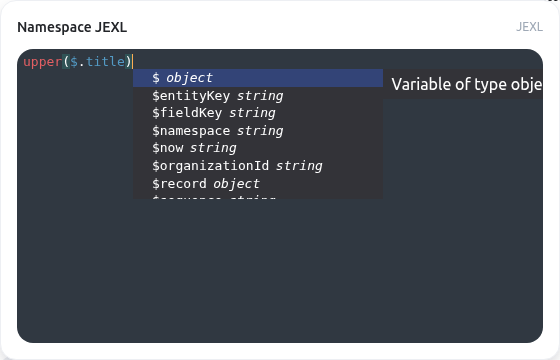
Call a helper as `trim($.request_reference)`. Not every helper is available everywhere: validation, form, and document-template helpers have distinct context contracts. Editor suggestions are not proof that a helper is supported at runtime.
## Complete function reference
### `camelCase`
Converts a string to camel case
**Signature:** `camelCase(str)`
**Example:**
```txt theme={null}
camelCase("hello world") // "helloWorld"
```
**Note:** It can also be written as a transform when the first value is the input: `value | camelCase(...)`.
### `capitalize`
Capitalizes the first letter of a string
**Signature:** `capitalize(str)`
**Example:**
```txt theme={null}
capitalize("hello") // "Hello"
```
**Note:** It can also be written as a transform when the first value is the input: `value | capitalize(...)`.
### `charCount`
Counts the number of characters in a string
**Signature:** `charCount(str)`
**Example:**
```txt theme={null}
charCount("hello") // 5
```
**Note:** It can also be written as a transform when the first value is the input: `value | charCount(...)`.
### `count`
Counts occurrences of a substring in a string
**Signature:** `count(str, search)`
**Example:**
```txt theme={null}
count("hello", "l") // 2
```
**Note:** It can also be written as a transform when the first value is the input: `value | count(...)`.
### `countRegex`
Counts occurrences of a regex in a string
**Signature:** `countRegex(str, regex, flags?)`
**Example:**
```txt theme={null}
countRegex("a1b2c3", "\\d", "g") // 3
```
**Note:** It can also be written as a transform when the first value is the input: `value | countRegex(...)`.
### `endsWith`
Checks if a string ends with a specified substring
**Signature:** `endsWith(str, substring)`
**Example:**
```txt theme={null}
endsWith("hello", "lo") // true
```
**Note:** It can also be written as a transform when the first value is the input: `value | endsWith(...)`.
### `escapeHtml`
Escapes HTML special characters in a string
**Signature:** `escapeHtml(str)`
**Example:**
```txt theme={null}
escapeHtml("hello
") // "<div>hello</div>"
```
**Note:** It can also be written as a transform when the first value is the input: `value | escapeHtml(...)`.
### `initials`
Extracts the initials from a string
**Signature:** `initials(str)`
**Example:**
```txt theme={null}
initials("John Doe") // "JD"
```
**Note:** It can also be written as a transform when the first value is the input: `value | initials(...)`.
### `kebabCase`
Converts a string to kebab case
**Signature:** `kebabCase(str)`
**Example:**
```txt theme={null}
kebabCase("hello world") // "hello-world"
```
**Note:** It can also be written as a transform when the first value is the input: `value | kebabCase(...)`.
### `lines`
Splits a string into an array of lines
**Signature:** `lines(str)`
**Example:**
```txt theme={null}
lines("line1\nline2\nline3") // ["line1", "line2", "line3"]
```
**Note:** It can also be written as a transform when the first value is the input: `value | lines(...)`.
### `lower`
Converts a string to lowercase
**Signature:** `lower(str)`
**Example:**
```txt theme={null}
lower("HELLO") // "hello"
```
**Note:** It can also be written as a transform when the first value is the input: `value | lower(...)`.
### `mask`
Masks a string by replacing characters with a specified character
**Signature:** `mask(str, maskChar, start, end)`
**Example:**
```txt theme={null}
mask("hello world", "*", 2, 8) // "he******d"
```
**Note:** It can also be written as a transform when the first value is the input: `value | mask(...)`.
### `matchRegex`
Returns all matches of a regex against the string
**Signature:** `matchRegex(str, regex, flags?)`
**Example:**
```txt theme={null}
matchRegex("a1b2", "\\d", "g") // ["1","2"]
```
**Note:** It can also be written as a transform when the first value is the input: `value | matchRegex(...)`.
### `normalizeSpace`
Removes duplicate consecutive whitespace characters.
**Signature:** `normalizeSpace(str)`
**Example:**
```txt theme={null}
normalizeSpace(" hello world ") // "hello world"
```
**Note:** It can also be written as a transform when the first value is the input: `value | normalizeSpace(...)`.
### `pad`
Pads a string to a specified length with another string
**Signature:** `pad(str, targetLength, padString?)`
**Example:**
```txt theme={null}
pad("hello", 10) // " hello"
```
**Note:** It can also be written as a transform when the first value is the input: `value | pad(...)`.
### `padEnd`
Pads a string from the end with another string
**Signature:** `padEnd(str, targetLength, padString?)`
**Example:**
```txt theme={null}
padEnd("hello", 10) // "hello "
```
**Note:** It can also be written as a transform when the first value is the input: `value | padEnd(...)`.
### `padStart`
Pads a string from the start with another string
**Signature:** `padStart(str, targetLength, padString?)`
**Example:**
```txt theme={null}
padStart("hello", 10) // " hello"
```
**Note:** It can also be written as a transform when the first value is the input: `value | padStart(...)`.
### `pascalCase`
Converts a string to Pascal case
**Signature:** `pascalCase(str)`
**Example:**
```txt theme={null}
pascalCase("hello world") // "HelloWorld"
```
**Note:** It can also be written as a transform when the first value is the input: `value | pascalCase(...)`.
### `repeat`
Repeats a string a specified number of times
**Signature:** `repeat(str, count)`
**Example:**
```txt theme={null}
repeat("hello", 3) // "hellohellohello"
```
**Note:** It can also be written as a transform when the first value is the input: `value | repeat(...)`.
### `replace`
Replaces the first occurrence of a substring with another string
**Signature:** `replace(str, oldStr, newStr)`
**Example:**
```txt theme={null}
replace("hello world", "world", "there") // "hello there"
```
**Note:** It can also be written as a transform when the first value is the input: `value | replace(...)`.
### `replaceAll`
Replaces all occurrences of a substring with another string
**Signature:** `replaceAll(str, oldStr, newStr)`
**Example:**
```txt theme={null}
replaceAll("hello world world", "world", "there") // "hello there there"
```
**Note:** It can also be written as a transform when the first value is the input: `value | replaceAll(...)`.
### `replaceLast`
Replaces the last occurrence of a substring with another string
**Signature:** `replaceLast(str, search, replace)`
**Example:**
```txt theme={null}
replaceLast("a-b-c-b", "b", "X") // "a-b-c-X"
```
**Note:** It can also be written as a transform when the first value is the input: `value | replaceLast(...)`.
### `replaceRegex`
Replaces substrings matched by a regex pattern with a replacement string
**Signature:** `replaceRegex(str, regex, replace, flags?)`
**Example:**
```txt theme={null}
replaceRegex("abc123", "\\d+", "#") // "abc#"
```
**Note:** It can also be written as a transform when the first value is the input: `value | replaceRegex(...)`.
### `slug`
Converts a string to a URL-friendly slug
**Signature:** `slug(str)`
**Example:**
```txt theme={null}
slug("Hello World!") // "hello-world"
```
**Note:** It can also be written as a transform when the first value is the input: `value | slug(...)`.
### `snakeCase`
Converts a string to snake case
**Signature:** `snakeCase(str)`
**Example:**
```txt theme={null}
snakeCase("hello world") // "hello_world"
```
**Note:** It can also be written as a transform when the first value is the input: `value | snakeCase(...)`.
### `split`
Splits a string into an array of substrings
**Signature:** `split(str, separator)`
**Example:**
```txt theme={null}
split("a,b,c", ",") // ["a", "b", "c"]
```
**Note:** It can also be written as a transform when the first value is the input: `value | split(...)`.
### `startsWith`
Checks if a string starts with a specified substring
**Signature:** `startsWith(str, substring)`
**Example:**
```txt theme={null}
startsWith("hello", "he") // true
```
**Note:** It can also be written as a transform when the first value is the input: `value | startsWith(...)`.
### `substr`
Extracts a substring from a string
**Signature:** `substr(str, start, end?)`
**Example:**
```txt theme={null}
substr("hello", 1, 3) // "el"
```
**Note:** It can also be written as a transform when the first value is the input: `value | substr(...)`.
### `titleCase`
Converts a string to title case
**Signature:** `titleCase(str)`
**Example:**
```txt theme={null}
titleCase("hello world") // "Hello World"
```
**Note:** It can also be written as a transform when the first value is the input: `value | titleCase(...)`.
### `trim`
Removes whitespace from both ends of a string
**Signature:** `trim(str)`
**Example:**
```txt theme={null}
trim(" hello ") // "hello"
```
**Note:** It can also be written as a transform when the first value is the input: `value | trim(...)`.
### `trimEnd`
Removes whitespace from the end of a string
**Signature:** `trimEnd(str)`
**Example:**
```txt theme={null}
trimEnd(" hello ") // " hello"
```
**Note:** It can also be written as a transform when the first value is the input: `value | trimEnd(...)`.
### `trimStart`
Removes whitespace from the start of a string
**Signature:** `trimStart(str)`
**Example:**
```txt theme={null}
trimStart(" hello ") // "hello "
```
**Note:** It can also be written as a transform when the first value is the input: `value | trimStart(...)`.
### `truncate`
Truncates a string to a specified length
**Signature:** `truncate(str, length)`
**Example:**
```txt theme={null}
truncate("hello world", 5) // "hello"
```
**Note:** It can also be written as a transform when the first value is the input: `value | truncate(...)`.
### `unescapeHtml`
Unescapes HTML special characters in a string
**Signature:** `unescapeHtml(str)`
**Example:**
```txt theme={null}
unescapeHtml("<div>hello</div>") // "hello
"
```
**Note:** It can also be written as a transform when the first value is the input: `value | unescapeHtml(...)`.
### `upper`
Converts a string to uppercase
**Signature:** `upper(str)`
**Example:**
```txt theme={null}
upper("hello") // "HELLO"
```
**Note:** It can also be written as a transform when the first value is the input: `value | upper(...)`.
### `wordCount`
Counts the number of words in a string
**Signature:** `wordCount(str)`
**Example:**
```txt theme={null}
wordCount("hello world") // 2
```
**Note:** It can also be written as a transform when the first value is the input: `value | wordCount(...)`.
## Before you publish
* Start with a known value and confirm the expected result.
* Handle null, empty text, and empty lists deliberately.
* Do not place secrets, access tokens, or sensitive personal data in an expression.
* Read [expression contexts and availability](/reference/expressions/contexts) before copying an expression between features.